
A SaaS sales funnel is the path a prospect takes from first hearing about your product to becoming a paying, retained customer. Аnd unlike a traditional funnel, it doesn’t stop at the sale.
After 10+ years in SEO and content marketing, including senior roles at SiteGround and Brosix, I’ve seen how much revenue leaks through broken SaaS sales funnels.
Companies pour budget into acquiring leads, then lose them somewhere between the first demo and the second billing cycle.
In this article, I break down every stage, the metrics worth tracking, and where most funnels fall apart.
Key Takeaways
- A SaaS sales funnel has 7 stages: awareness, interest, consideration, intent, evaluation, purchase, and retention.
- The B2B SaaS sales funnel moves slower and involves more stakeholders than B2C.
- Weak onboarding, not weak acquisition, is where most SaaS funnels lose revenue.
- Marketing fills the funnel, sales converts it, but they need shared metrics to work together.
What Is a SaaS Sales Funnel?
A SaaS sales funnel is a structured framework that maps the stages a prospect moves through, from first discovering your software to becoming a paying, renewing customer. It’s the operational backbone of how a SaaS company turns interest into recurring revenue.
You start with a large pool of potential customers at the top of the funnel and end with a smaller, better-qualified group at the bottom.
What separates the sales funnel for SaaS from a traditional one is what happens after the deal closes. In SaaS, a signed contract doesn’t deliver revenue on its own. The customer has to keep paying, month after month. That changes everything about how you build, measure, and optimize the funnel.
SaaS Sales Funnel vs. SaaS Marketing Funnel
The SaaS marketing funnel pulls in a broad audience through content, ads, and organic search, building awareness and generating demand across a wide pool of potential buyers. A SaaS sales funnel picks up when a prospect signals intent, turning a qualified lead into a paying customer through direct conversations, demos, and trials.
| Feature | SaaS marketing funnel | SaaS sales funnel |
| Primary goal | Generate awareness and demand | Qualify prospects and close deals |
| How it works | Automated, content-driven, broad reach | Targeted, interaction-driven, high-touch |
| Who it targets | Wide audiences by role or industry | Specific companies and decision-makers |
| Key metric | Traffic, Marketing Qualified Leads (MQLs), content engagement | Sales Qualified Leads (SQLs), demo-to-close rate, Annual Contract Value (ACV) |
The marketing funnel ends when a prospect requests a demo, signs up for a free trial, or hits a usage threshold on a freemium plan. At that point, the sales funnel takes over. A sales rep steps in, qualifies the lead, runs discovery calls, and moves the deal through to close.
The handoff between the two is where most SaaS revenue problems originate. Marketing optimizes for MQL volume. Sales optimizes for close rate. When neither team owns the gap between those two metrics, good leads disappear without anyone noticing.
B2B vs. B2C SaaS Sales Funnel: Key Differences
A B2B SaaS sales funnel and a B2C one share the same basic shape, but the details inside each stage look very different. B2B buyers move slower and involve more people, while B2C buyers decide fast and often act alone.
Here’s how B2B and B2C sales funnels for SaaS compare:
| Factor | B2B SaaS funnel | B2C SaaS funnel |
| Sales cycle length | Weeks to months | Minutes to days |
| Decision-makers | Multiple stakeholders | Usually one individual |
| Entry point | Demo request, gated content | Free trial, freemium sign-up |
| Content that converts | Case studies, ROI calculators | Reviews, quick-start guides |
| Primary channels | Outbound sales, LinkedIn, Account-Based Marketing (ABM) | Paid social, app stores, word-of-mouth |
| Pricing conversations | Negotiated, often custom | Fixed, transparent tiers |
| Key funnel metric | MQL-to-SQL, sales cycle length | Trial-to-paid, activation rate |
| Retention driver | Account management, expansion | Product stickiness, habit formation |
The biggest difference between B2C and B2B SaaS sales funnels comes down to who makes the decision and how fast they make it.
B2B SaaS funnels are built around trust and consensus. B2C funnels are built around speed and self-service. That’s why B2B leans on sales teams and ROI-focused content, while B2C leans on product experience and instant value delivery.
What Are the Stages of a SaaS Sales Funnel?
The SaaS sales funnel has seven stages—awareness, interest, consideration, intent, evaluation, purchase, and retention. These stages are grouped into 3 levels—top of the funnel (TOFU), middle of the funnel (MOFU), and bottom of the funnel (BOFU).
- The top of the funnel (TOFU) covers awareness and interest, where you attract new visitors and generate leads.
- The middle of the funnel (MOFU) covers consideration and intent, where prospects evaluate your product and compare alternatives.
- The bottom of the funnel (BOFU) covers evaluation, purchase, and retention, where deals are closed, and revenue is secured.
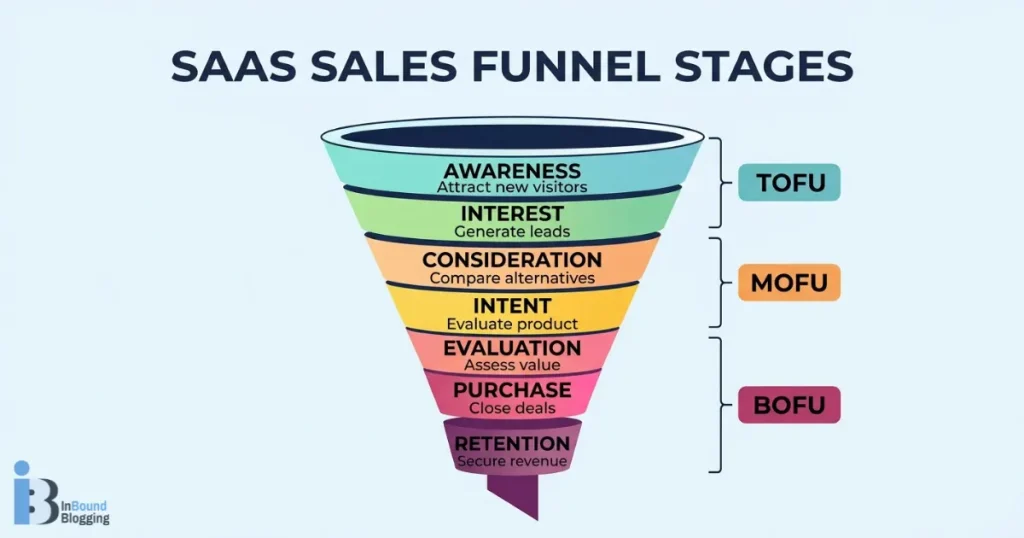
Here’s how each stage of the SaaS sales funnel breaks down:
1. Awareness
Awareness is where a prospect first realizes they have a problem your product solves. They haven’t heard of you yet, but they’re searching Google, reading industry content, or getting recommendations.
At this stage, you need to show up where they look. You don’t sell anything here. You publish educational content that answers the questions your target audience asks.
The most effective awareness channels for SaaS companies are:
- organic search
- content marketing
- paid ads
- social media
Key metrics for the awareness stage: Visitor-to-lead rate, organic traffic growth, branded search volume.
2. Interest
At the interest stage, the prospects stop passively browsing and start actively engaging. They’ve moved past “I have a problem” to “let me learn more about how to solve it.” They download guides, join email lists, or compare options.
Lead nurturing through email sequences, retargeting ads, and targeted content marketing keeps your product front of mind. Sales typically aren’t involved yet. Prospects prefer self-service research before engaging in direct sales conversations.
Key metrics for the interest stage: Lead-to-MQL rate.
3. Consideration
At the consideration stage, prospects compare you against alternatives. They check your pricing page, read competitor comparisons, and decide whether your product is worth a real conversation. This happens at the MOFU level where SaaS content marketing does its heaviest work.
Effective consideration-stage assets include product comparison pages, case studies, webinars, product demos, and free trials.
Your goal is to give prospects enough information to make a confident decision while positioning your product as the best fit for their specific needs.
Key metrics for the consideration stage: MQL-to-SQL rate.
4. Intent
During the intent stage, the prospect is seriously considering a purchase. They start a free trial, request a formal quote, or loop in other stakeholders internally. This is the clearest buying signal you’ll see before a deal closes.
For self-serve SaaS products, intent and evaluation happen inside the product itself, which is why the onboarding process at this stage is so critical.
In sales-led models, sales reps use discovery calls to understand the prospect’s needs, budget, decision criteria, and timeline.
Key metrics for the intent stage: SQL-to-opportunity rate, trial sign-up rate.
5. Evaluation
Evaluation is the most drawn-out stage in B2B SaaS sales. Legal reviews the contract, IT vets security and integrations, and end users run a proof of concept before anyone signs off.
The deal is essentially won here, but it can still be lost through friction, slow response times, or a competitor who makes the process easier.
Your sales team’s job is to remove obstacles, not just answer questions. Provide references, run additional demos for new stakeholders, and make the procurement process as straightforward as possible.
Key metrics for the evaluation stage: Opportunity-to-close rate, sales cycle length.
6. Purchase
The purchase stage is where the customer signs the contract and sets up payment.
This stage is short, but how you handle it determines what comes next. A clunky handoff from sales to customer success creates a gap where excitement fades and doubts creep in.
SaaS statistics show that if users fail to experience value early on, more than 98% become inactive within two weeks, making the first few days critical for retention. That drop-off almost always traces back to a slow or unclear start, not a lack of interest.
Key metrics for the purchase stage: Time to first login, time to activation.
7. Retention
Retention is where the SaaS sales funnel diverges from every other type of funnel. Closing the deal is only the beginning. Your goal is to retain customers long enough to recover acquisition costs and grow revenue from them.
Retention is driven by the following three factors:
- smooth onboarding process
- consistent product value delivery
- proactive customer success outreach.
If users don’t reach their “aha moment” quickly, they churn. And churn is expensive.
Key metrics for the retention stage: Churn rate and Net Revenue Retention (NRR).
Retained customers who see real value become advocates and feed referrals and organic word-of-mouth back into the awareness stage.
For a deeper look at keeping customers past the purchase stage, see my posts on SaaS customer retention and SaaS retention rate.
How to Build a SaaS Sales Funnel From Scratch
Here’s how to build a SaaS sales funnel step by step:
1. Define your ICP (ideal customer profile)
Before you start building the sales funnel for SaaS, you must know who you’re building it for. Identify the types of companies you want to reach based on their size, industry, and the roles of the people who make purchasing decisions.
Understand their main pain points, what they need from your product, and how they evaluate and buy software. These details determine how you attract leads, what messages you use, and how you guide prospects through each stage of the funnel.
Without a well-defined ICP, you attract a mix of good-fit and poor-fit leads, which drags down conversion rates at every stage.
2. Build your lead generation strategy
The second step in your SaaS sales funnel is to choose two or three lead acquisition channels where your target audience is active and go deep. These are the places your ideal customers spend time and where they discover new software.
For B2B SaaS companies, such lead generation channels are SaaS SEO, content marketing, and either paid search or LinkedIn. Spreading across too many channels early on dilutes focus and makes it harder to identify what’s working.
3. Map content to funnel stages
Create content that matches what potential customers need to know at each SaaS funnel stage. For example, the first three stages can benefit from the following types of content:
- Awareness content answers broad questions through educational blog posts, guides, and industry reports.
- Consideration content compares and evaluates through comparison articles, alternatives pages, and product-focused webinars.
- Decision content removes final objections, using case studies, customer testimonials, product demos, and free trials.
Invest in SaaS keyword research to identify the specific queries your target audience uses at each stage, then build content around those queries systematically.
4. Build your trial or freemium experience
Your free trial or freemium plan is a critical stage of the SaaS funnel because users need to experience your product’s value before they decide to pay.
Map the steps from sign-up to activation, such as completing onboarding, setting up key features, or completing their first task.
Then, identify where users drop off and remove anything that prevents them from reaching the product’s core value quickly. The faster users see how your product solves their problems, the more likely they are to become paying customers.
5. Implement lead scoring
Not every lead is ready to talk to sales. Use lead scoring to identify prospects who are most likely to convert by combining company details, such as size and industry, with behavioral signals, such as pricing page visits, demo requests, and free trial activity.
Assign points to these attributes and actions, then set clear thresholds to determine the next step.
Lower-scoring leads can receive automated emails that educate them about your product, while higher-scoring leads can go directly to sales for personalized follow-up.
6. Align sales and marketing on shared definitions
Sales and marketing must agree on what qualifies as a marketing-qualified lead (MQL) and a sales-qualified lead (SQL), when a lead is ready for sales, and who handles follow-up.
For example, marketing might define an MQL based on engagement with content or product interest, while sales qualifies an SQL based on buying intent, budget, and fit.
Set clear criteria and handoff rules so both teams work toward the same goals. Without this alignment, teams may count leads differently, miss follow-up opportunities, and struggle to identify where the funnel loses potential customers.
How to Diagnose a Leaky SaaS Sales Funnel
A leaky SaaS sales funnel loses potential customers at one or more stages before they become paying users. To find the problem, track conversion rates between stages, identify where the biggest drop-offs occur, and investigate what causes them.
A broken funnel doesn’t announce itself. It quietly costs you revenue, but this is the process I use to find the leaks:
- Map your conversion rate at every stage: Pull the conversion rate from visitor-to-lead, lead-to-MQL, MQL-to-SQL, SQL-to-opportunity, and opportunity-to-close into a single view. Without this full picture, it’s easy to fix a healthy stage while the real problem is elsewhere.
- Identify where the drop-off is highest: Compare each rate against industry benchmarks for your motion and segment. The stage with the biggest gap between your number and the benchmark is where your leak is.
- Segment leaks by channel and customer type: A blended SaaS conversion rate can hide a lot. Break it down by channel (SEO, paid, referral), customer segment (company size, industry, ICP fit), and entry point (trial vs. demo request). You’ll often find one channel is dragging down your average while others perform well.
- Compare cohorts over time: Look at how conversion rates for each monthly cohort change over time, not just where they stand today. This tells you whether a leak is a one-time issue or a sustained trend that needs a structural fix. It also shows you whether a change you made actually improved performance, rather than producing a temporary spike.
Here are the most common leaks I see:
- Weak onboarding killing trial-to-paid conversion.
- Marketing and sales misaligned on MQL definitions.
- No defined activation milestone, so nobody knows when a trial user is truly engaged.
- Customer success reacting to cancellations instead of preventing them.
B2B SaaS Sales Funnel Benchmarks
I made this table of the most important SaaS sales funnel metrics at each stage, with benchmarks for B2B SaaS:
| Funnel stage | What to measure | Benchmark for B2B SaaS | What it tells you |
| Awareness | Visitor-to-lead rate | SEO 2.1%; PPC 0.7% | How effectively your website turns visitors into leads |
| Interest | Lead-to-MQL rate | SEO 41%; email 43%; webinars 44% | Whether your leads match your marketing qualification criteria |
| Consideration | MQL-to-SQL rate | SEO 51%; email 46% | How many marketing-qualified leads sales accepts as qualified prospects |
| Intent | SQL-to-opportunity rate | SEO 49%; email 48% | How effectively qualified prospects progress to a sales opportunity |
| Evaluation | Opportunity-to-close rate | Webinars 40%; LinkedIn 39% | How often sales opportunities become customers |
| Purchase | Time to value; activation rate | No universal benchmark | How quickly new users experience your product’s core value |
| Retention | Customer churn rate | About 3.5% annual median in one B2B SaaS benchmark | How many customers you lose over time |
Pro tip: Don’t optimize for all of these at once. Identify the biggest gap stage between your current number and the benchmark, fix it first, and measure the compounding effect before moving to the next.
My Final Thoughts
A well-built SaaS sales funnel doesn’t end when someone signs a contract. It ends when that customer renews, expands, and sends you a referral.
Growing SaaS companies manage every funnel stage with the same discipline—from the first blog post a prospect reads to the follow-up email a customer success manager sends six months after signup.
Here’s a quick recap of what I recommend:
- Start by auditing your SaaS sales funnel metrics stage by stage.
- Find the leak.
- Fix the onboarding process before you double your ad spend.
- Get sales and marketing aligned on shared definitions.
- Build a trial experience that actually shows new users why your product is worth paying for.
Do those things consistently, and the funnel takes care of the rest.
FAQ
What is the difference between a SaaS sales funnel and a sales pipeline?
A SaaS sales funnel describes the stages a prospect moves through from awareness to retention, viewed from the buyer’s perspective. A sales pipeline describes the same journey from the seller’s perspective, tracking deals by stage, value, and probability of closing. The funnel tells you where prospects drop off; the pipeline tells you what revenue to expect and when.
When should a SaaS company use a freemium model instead of a free trial?
Freemium works best when your SaaS product delivers value quickly with limited features, and when a large user base creates network effects or viral growth. Free trials work better for complex products where users need access to the full feature set to understand the value. The wrong choice significantly affects trial-to-paid conversion rates and customer acquisition cost.
How do you calculate customer acquisition cost (CAC) for a SaaS sales funnel?
Divide your total sales and marketing spend for a given period by the number of new customers acquired in that same period. If you spent $50,000 in Q1 and acquired 100 new customers, your CAC is $500.
For the number to be meaningful, compare it against your average contract value (ACV) and customer lifetime value (LTV). A healthy LTV:CAC ratio for B2B SaaS is 3:1 or higher.
What is an MQL and how is it different from an SQL in a SaaS funnel?
A marketing qualified lead (MQL) is a prospect that fits your target audience and has shown enough engagement to be nurtured further, based on criteria like job title, company size, and content downloads. A sales qualified lead (SQL) is a prospect sales has reviewed and confirmed ready for a direct sales conversation, based on budget, authority, need, and timeline.
What is the difference between a sales-led and a product-led SaaS funnel?
In a sales-led funnel (SLG), a human sales team drives conversion at every key stage through demos, discovery calls, and proposals. In a product-led funnel (PLG), the product itself drives conversion—prospects sign up, experience value directly, and upgrade without talking to a sales rep. The right model depends on your product’s complexity, price point, and how quickly a new user can reach their first meaningful outcome.
How does product-led growth (PLG) change the role of a sales team?
In a PLG model, the sales team shifts from generating demand to expanding it. Instead of cold outreach and demos, sales focuses on identifying high-usage free or trial accounts that show buying signals, then reaching out to convert them to paid plans or expand them into higher tiers. This motion is called “sales-assisted PLG,” and it’s how companies like Slack and Notion scaled enterprise revenue without a traditional outbound sales function.
What tools do SaaS companies use to manage their sales funnel?
The most common SaaS sales funnel stack includes a CRM (HubSpot, Salesforce) to track deals by stage, a marketing automation platform (Marketo, ActiveCampaign) to manage lead nurturing, a product analytics tool (Amplitude, Mixpanel) to track activation and churn rate, and a customer success platform (Gainsight, ChurnZero) to manage retention. Your tools must share accurate, consistent data so every team has a clear view of the customer journey.