
A SaaS marketing funnel is a framework that maps the stages potential customers go through, from discovering a software product to becoming paying customers and staying with the business.
Unlike a traditional funnel that ends at purchase, the SaaS version keeps going because recurring revenue depends on what happens after the signup.
After 10+ years in SEO and content marketing, including senior roles at SiteGround and Brosix, I’ve learned that traffic alone doesn’t grow a SaaS business. What matters is how well you turn that traffic into leads, customers, and revenue.
In this guide, I break down each stage, the metrics worth tracking, and the conversion gaps that could cost you customers.
Key Takeaways
- A SaaS marketing funnel has 5 stages: awareness, consideration, decision, retention, and advocacy.
- Conversion isn’t the finish line; retention and expansion drive recurring revenue.
- Marketing, product, and customer success teams must share ownership of the funnel.
- Most funnels break down at onboarding, not at the top.
What Is a SaaS Marketing Funnel?
A SaaS marketing funnel is a framework that maps the full customer journey, from the first time someone discovers your product to becoming a loyal, paying user who refers others.
Not everyone who enters at the top of the SaaS funnel makes it to the bottom. You attract a large pool of potential customers through content marketing, social media, paid ads, and SEO. A smaller portion engages seriously, a smaller portion converts, and even a smaller group stays and renews the subscription.
What separates the marketing funnel for SaaS from a standard funnel is the subscription model. In SaaS, a closed deal doesn’t generate revenue on its own. The customer has to keep paying, month after month or year after year. That determines how you build and measure the SaaS funnel.
Marketing, product, sales, and customer success all play a role in the funnel. Every team contributes to the funnel’s success.
What Is the Difference between a SaaS Marketing Funnel and a SaaS Sales Funnel?
The main difference is that a SaaS marketing funnel focuses on attracting and nurturing potential customers, while a SaaS sales funnel focuses on converting qualified leads into paying customers.
The SaaS marketing funnel covers the entire customer journey, from awareness through advocacy. It covers the following objectives:
- Generate demand
- Attract the right target audience
- Nurture qualified leads
- Prepare prospects for a sale
The SaaS sales funnel is a subset of the marketing funnel. It starts when marketing passes a marketing qualified lead (MQL) to the sales team. It focuses on converting prospects into paying customers through demos, proposals, and direct sales conversations. During this process, sales qualifies MQLs as sales qualified leads (SQLs) when they meet the criteria for direct sales engagement.
To sum it up:
Marketing fills the funnel and warms the leads, while sales closes the deal.
SaaS companies run into trouble when these two functions operate in silos. Marketing optimizes for MQL volume, sales optimizes for close rate, and nobody owns the gap in between. That gap is where good leads go to die. The most effective SaaS teams work together around shared pipeline metrics, not departmental ones.
If you need help writing SaaS content that generates qualified leads at every funnel stage, our service covers the full customer journey.
What Are the 5 SaaS Marketing Funnel Stages?
The 5 stages of a SaaS marketing funnel are awareness, consideration, decision, retention, and advocacy.
Let me explain them in more detail below with the help of a SaaS marketing funnel diagram.
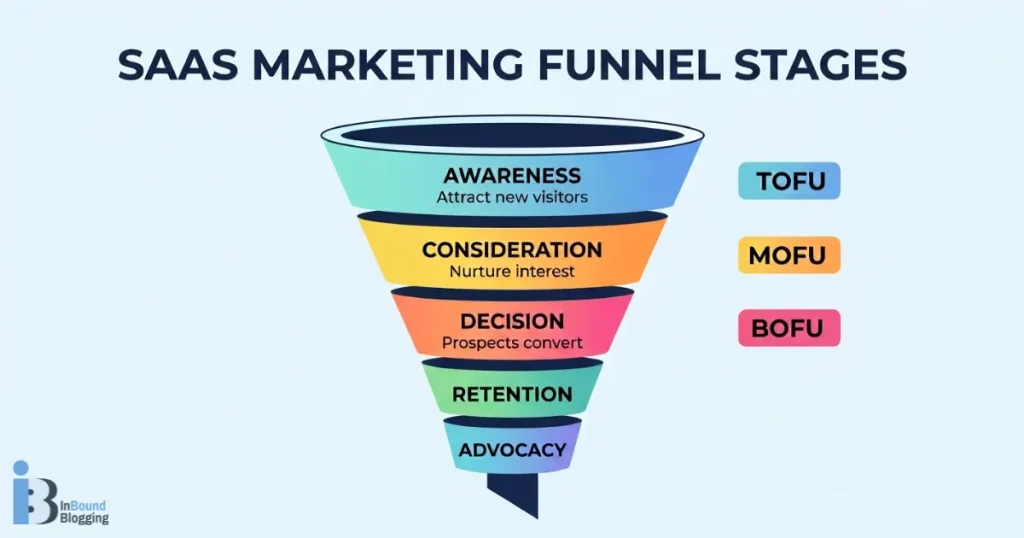
The funnel is typically divided into three levels: top of the funnel (TOFU), middle of the funnel (MOFU), and bottom of the funnel (BOFU).
- TOFU covers awareness, where you attract new visitors.
- MOFU covers consideration, where you nurture interest.
- BOFU covers the decision stage, where prospects convert.
Retention and advocacy sit beyond BOFU, and that’s what separates a SaaS marketing funnel from a standard one.
Here’s how each stage breaks down in practice.
1. Awareness
Awareness is the top of the funnel. A potential SaaS customer has a problem but doesn’t know your product exists yet. Your job is to show up where they’re looking.
The most effective awareness channels for SaaS are organic search (SEO), content marketing, social media, paid ads, and link building.
At this stage, you’re not selling anything. You’re publishing blog posts, comparison guides, and educational content that answers the questions your target audience already asks.
The metrics to watch in the awareness stage are organic traffic growth and branded search volume over time.
SaaS SEO is one of the highest-ROI awareness channels available, with SEO-generated leads converting from MQL to SQL at roughly double the rate of PPC leads.
2. Consideration
During the consideration stage, the prospect knows your SaaS product exists and is evaluating it against alternatives. This is where content marketing does its heaviest lifting.
Effective consideration-stage assets include the following:
- Product comparison pages (“Your Tool vs. Competitor”)
- Case studies and customer success stories
- Webinars and product demos
- Email nurture sequences
- Free trials or freemium access
Your goal is to help prospects understand how your SaaS product meets their needs so they can make an informed decision. At this stage, retargeting ads remind them of your product as they compare their options.
3. Decision
During the decision stage, the prospect is ready to commit. Now, factors such as pricing page clarity, trial experience, social proof, and onboarding quality determine whether prospects convert into customers.
Free trials are the standard SaaS conversion mechanism, and many companies leak significant revenue here. Around 30% of users who start a free trial that requires a credit card become paying customers. That’s more than five times the conversion rate of trials that don’t require a credit card.
Other strong decision-stage tactics include:
- Live chat and customer support availability
- ROI calculators
- Clear comparison tables
- Case studies that mirror the prospect’s industry or company size
4. Retention
The retention stage is the period after purchase when a SaaS company helps customers get value from its product, stay satisfied, and renew their subscriptions.
Retention is where SaaS diverges most sharply from traditional marketing models. In SaaS, winning the customer is the beginning, not the end.
Retention is driven by these three factors:
- Smooth onboarding process
- Consistent product value delivery
- Proactive customer success outreach.
If users don’t reach their “aha moment” quickly, they churn. And churn is expensive. Replacing a lost customer costs significantly more than keeping one.
Key retention tactics in the SaaS marketing funnel involve:
- Structured onboarding sequences with completion rate tracking
- Regular check-ins and usage-based triggers
- In-app guidance and education
- Customer support that resolves issues fast
At the retention stage, churn rate is a key metric to track. For enterprise SaaS, annual churn of 2%–5% is the benchmark. For SMB-focused SaaS products,10%–14% is more common.
Other important retention metrics are SaaS customer retention and SaaS retention rate.
5. Advocacy
The advocacy stage comes when satisfied customers recommend your SaaS product through referrals, reviews, and testimonials.
Retained customers who see real value become your most cost-effective acquisition channel. Advocacy takes the form of referrals, reviews on G2 or Capterra, case studies, and word-of-mouth.
Advocacy feeds directly back into awareness and consideration for new prospects. A strong review profile lowers your cost per acquisition. A referral program turns existing customers into a distribution channel. Cross-sell and upsell opportunities within your existing customer base also generate expansion revenue, which is what drives net revenue retention (NRR) above 100%.
Top-performing SaaS companies achieve NRR of about 110%–120% or higher, meaning they grow revenue from existing customers even without adding new ones.
What Metrics Should You Track at Each Funnel Stage?
Here’s a practical breakdown of the most important metrics for each SaaS marketing funnel stage:
| Funnel Stage | Primary Metric |
| Awareness | Organic traffic, branded search |
| Consideration | MQL volume, email open rates |
| Decision | Trial-to-paid conversion rate, demo-to-customer conversion rate |
| Retention | Churn rate, onboarding completion rate, product adoption rate |
| Advocacy | Referral rate, customer reviews, NRR |
The most important thing is to track your SaaS marketing metrics at each stage and identify the biggest drop-offs.
From what I’ve seen, SaaS companies have one or two stages that significantly underperform relative to the rest. You must fix those first.
How to Build a Marketing Funnel Model for SaaS
Building a marketing funnel model for SaaS from scratch comes down to the following five steps:
- Define your ICP (Ideal Customer Profile): For B2C SaaS, define your target audience by demographics, goals, pain points, product needs, and buying behavior. If you sell a B2B SaaS product, identify the types of companies you want to reach, including their size, industry, needs, and buying process. Use these insights to guide every funnel decision.
- Map your content to funnel stages: Awareness content answers broad questions. Consideration content compares and evaluates. Decision content removes final objections. SaaS companies typically over-invest in awareness content and leave consideration and decision stages thin.
- Choose your primary acquisition channels: Don’t try to do everything. Pick two or three channels where your target audience is active and go deep. For B2B SaaS products, that’s SEO, content marketing, paid search, or LinkedIn. For B2C SaaS, focus on SEO, social media, paid ads, app stores, or influencer marketing.
- Build your trial or freemium experience: Your free trial is a funnel stage in itself. Map the steps a new user takes, identify where they drop off, and optimize for activation—the point at which a user first experiences your product’s core value.
- Align marketing and sales around shared definitions: Agree on what an MQL is, what an SQL is, when the handoff happens, and who owns follow-up. Without this, your SaaS conversion funnel data is unreliable, and your teams optimize against each other.
SaaS link building is one way to accelerate awareness-stage growth in organic search. By earning relevant backlinks from other sites, you improve search visibility and bring qualified traffic to your website.
Where Most SaaS Marketing Funnels Break Down
SaaS marketing funnels break down due to the following four reasons:
- Treating the funnel as linear
- Weak onboarding killing trial-to-paid conversion
- Marketing and product operating in silos
- Over-investing in TOFU while neglecting retention
I’ve seen these reasons throughout my practice, and I want to explain them in more depth below:
Treating the funnel as linear
Real customer journeys aren’t straight lines. A SaaS prospect might see your product on social media, read a blog post three weeks later, attend a webinar, and then start a free trial after seeing a retargeting ad.
That’s why SaaS funnels that assume a clean left-to-right path misattribute conversions and misallocate budget.
Weak onboarding killing trial-to-paid conversion
Weak onboarding is the single most common revenue leak I see in SaaS. Companies invest heavily in getting users to sign up for a free trial, then leave them to figure out the product alone.
If users don’t reach activation within the first few sessions, they churn before they pay. A structured onboarding process with clear milestones and proactive customer support fixes that.
Marketing and product operating in silos
SaaS product marketing brings people to you, but the product experience determines whether they become paying customers and stay.
If marketing and product teams don’t share data, marketing may not know why users leave during the trial or cancel their subscriptions. As a result, both teams miss chances to turn more users into long-term customers.
Over-investing in TOFU while neglecting retention
Customer acquisition gets most of the attention and most of the funnel budget. But in a subscription business like SaaS, reducing churn by even one or two percentage points has a larger compounding effect on revenue than increasing new customer acquisition by the same margin.
That’s why retention deserves a dedicated strategy, not just a customer success team that reacts to cancellations.
My Final Thoughts
A well-built SaaS marketing funnel doesn’t end at the sale. It runs from the first blog post a prospect reads to the referral they send three years into their subscription.
The companies that grow predictably treat every funnel stage with the same discipline, not just the top.
My advice is to take care of these critical funnel aspects:
- Start by auditing where your funnel leaks.
- Fix retention before you double your ad spend.
- Get marketing and sales aligned on shared metrics.
- Build a trial experience that shows new users why your product is worth paying for.
Get these fundamentals right, and the funnel takes care of the rest.
FAQ
How long does it take to build a SaaS marketing funnel?
A basic SaaS funnel structure, with defined ICP, content mapped to each stage, and an optimized trial experience, takes four to eight weeks to set up properly. Seeing meaningful results from content marketing and SEO typically takes three to six months. Paid acquisition channels produce results faster but at a higher ongoing cost.
What metrics matter most in a SaaS marketing funnel?
The most important metrics are organic traffic growth (awareness), MQL-to-SQL conversion rate (consideration), trial-to-paid conversion rate (decision), churn rate (retention), and net revenue retention (advocacy). Tracking these across all SaaS marketing funnel stages gives you a clear picture of where to focus optimization efforts.
Why do most SaaS marketing funnels fail?
Most SaaS marketing funnels fail because of weak onboarding, not weak acquisition. Companies invest in getting users to sign up, then fail to show them enough value to convert to a paid subscription. Other common causes include misaligned marketing and sales teams, treating the funnel as linear, and over-investing in top-of-funnel activities while ignoring retention.