
So, what do you gain from acquiring links manually?
Higher rankings, stronger domain authority, and lasting credibility in your niche.
And who doesn’t want that?
As an SEO expert specializing in link building strategies, I’m in a position to give you advice on how to gain relevant links with manual tactics.
If you’re ready for a stronger online presence and want to make an effort to achieve it, this article is for you.
Roll up your sleeves, and let’s get started.
Key Takeaways
- Unlike automated methods, manual link acquisition offers greater control, quality assurance, and alignment with Google’s guidelines.
- The most effective manual strategies include guest posting, the skyscraper technique, broken link building, resource page link building, link reclamation, digital PR, and HARO link building.
- Choose your target websites based on relevance, authority, and audience fit.
What Is Manual Link Building in SEO?
Manual link building in SEO is a process where you create backlinks manually to your website or content. It involves tactics like resource page link building, link reclamation, and outreach for relationship building.
Through trial and error, I’ve understood that manual link earning requires patience and accuracy. While it demands more time and personalized effort, the results justify the investment. You get superior, pertinent links that enhance your website’s credibility without the risk of Google penalties.
Comparison With Automated Link Building
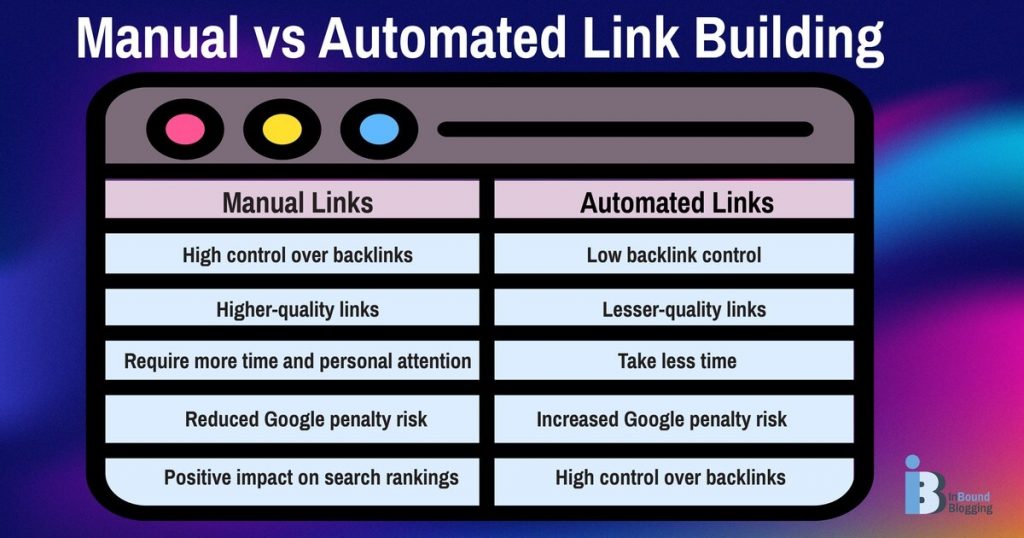
Google’s SpamBrain artificial intelligence (AI) got smarter at spotting spammy link strategies. This tech shift means avoiding automated link builders is a must. These are bots and software that can produce many links in a short time. However, the quality of these links is questionable. If your site is paired with irrelevant sites with a bad online reputation, Google might drop your website down in the search results or completely exclude it from them.
Having explored different link building techniques, I’ve found clear differences between manual and automated link building:
- Control over backlinks: Manual backlink building allows high control over strategic placement and relevance, whereas automated link building has low control as the software targets websites indiscriminately.
- Quality of backlinks: Manual link acquisition results in premium links from authoritative, relevant websites, while automated tactics often yield inconsistent, lesser-quality links from unrelated or spam-like sites.
- Time and effort: Manual links require more time and personal attention, while automated ones take less time as software handles the process.
- Risk of Google penalties: Manual linking reduces risk due to contextual and high-quality links, while automated linking increases risk by creating spam-like or unnatural links.
- Impact on search rankings: Human-curated link building has a beneficial impact by improving website authority through carefully selected links, whereas automated link building has an uncertain or minimal impact due to low-quality links.
Effective Manual Link Building Strategies
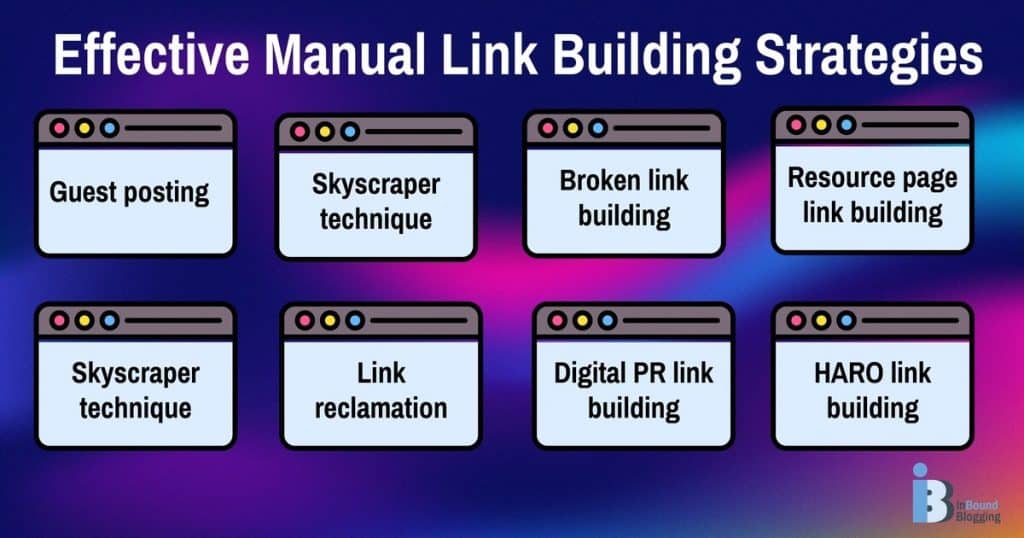
For those looking to boost their site’s reach, manual link building is key. It involves creating backlinks that drive real value.
Guest posts on other blogs, fixing broken links with your own resources, and getting the word out through digital news count as smart moves.
Guest posting
Writing content for other websites to gain exposure and build backlinks is a powerful strategy. Here’s how I do it:
- Select relevant websites: I choose sites relevant to my niche with high traffic and authority. When reputable websites link to your website, search engines view this as a sign of trust and reward you accordingly.
- Pitch original ideas: I pitch article ideas that match the site’s target audience and showcase my profound understanding of the subject matter. The combination of experience, expertise, authoritativeness, and trustworthiness (E-E-A-T) is a major ranking factor today.
- Create high-quality content: My content is informative, engaging, and well-written, and it includes natural links back to my website.
- Share and network: I share guest posts across my digital channels to improve my brand awareness and build relationships with site owners for future opportunities.
- Track performance: I monitor the SEO impact of my guest posts and refine my strategy accordingly.
Skyscraper technique
The skyscraper technique involves identifying successful content and creating something superior. Here’s my approach:
- Identify successful content: I find highly successful content in my area of interest with plenty of social shares and links.
- Develop superior content: I create content that adds more value, includes more recent and unique data, and discusses the subject in greater depth.
- SEO outreach: I contact websites linking to the original article, presenting them with my enhanced version.
- Monitor backlinks: I track the backlinks accumulated through this method and update my content regularly to maintain its value. Here’s a little secret: I often use Perplexity AI for fact checking and save a great deal of time when updating my texts.
Broken link building
Broken links are hyperlinks on a website that no longer lead to the intended page, often resulting in a “404 Not Found” error. This is an excellent opportunity to build links.
Here’s how I do it:
- Find broken links: I use tools like Ahrefs to identify pages with broken links.
- Create or update content: I create high-quality content or edit my existing pieces to replace the dead link.
- Outreach: I reach out to the website owner with a personalized email suggesting my content as an alternative. Patience is key; not everyone replies quickly. Sometimes it takes multiple emails to get a response.
- Track progress: I note which sites added my link and monitor the SEO and traffic impact of the linked page.
Want to know everything about backlinks in SEO? I’ve prepared an extensive link building glossary with all the terms you need.
Resource page link building
Resource page link building is another powerful technique worth mentioning. I aim to get my content listed on high-authority pages that curate and link to valuable resources. Here’s my process:
- Identify relevant resource pages: I use search operators like “keyword + resources” or “keyword + inurl:links” to find suitable pages within my niche.
- Personalized outreach: I contact the webmasters with a tailored message, explaining how my content can add value to their resource list.
- Highlight quality and relevance: I emphasize the relevance and quality of my resource to increase the chances of earning a spot on these authoritative pages.
Link reclamation
Link reclamation is about recovering lost backlinks that once directed traffic to your website. By focusing on link reclamation, I can effectively restore my site’s SEO strength and maintain valuable connections that benefit my online presence.
This is what I do:
- Identifying lost links: I start by auditing my website’s backlink profile using link building tools to find broken or removed links.
- Outreach: Once I spot the lost links, I contact the webmasters of those sites with a polite email, requesting them to update or restore the link to my current content.
Reclaiming lost backlinks boosts my website’s authority, improves traffic, and strengthens my overall link profile without needing to build new links from scratch.
Digital PR link building
Digital PR link building is an active strategy that involves creating compelling content to attract journalists, bloggers, and influencers, leading to valuable backlinks and increased online visibility.
Here’s how you can implement it effectively:
- Develop newsworthy content: Create press releases, case studies, and original research that are timely, relevant, and interesting to catch the attention of big news sites and media outlets.
- Engage in storytelling: Use powerful storytelling techniques to make your content more appealing and shareable.
- Find the right journalist: Specialized platforms like Muck Rack, Roxhill Media, Vuelio, and Prowly help you find journalists who cover topics relevant to your content and are likely to find it useful.
- Leverage social media: Share your content on social media platforms to reach a wider audience and catch the eye of journalists and influencers.
- Network with media contacts: Build and maintain relationships with journalists, bloggers, and influencers in your industry to increase the chances of your content being featured.
- Monitor trends: Stay updated on industry trends and news to create content that aligns with what journalists are currently covering.
- Track your success: Use tools like Google Analytics to track where your backlinks are coming from and measure the impact on your website’s SEO and traffic.
HARO link building
Using HARO link building can really boost your website’s credibility and help you get noticed online. This is what you should do:
- Reach out to journalists: Use platforms like HARO, Featured, MentionMatch, Qwoted, Sourcebottle, and Source of Sources (SOS) to connect with journalists and bloggers seeking expert insights.
- Craft exceptional quotes: By providing valuable insights, authoritative and credible websites cite me in their publications, improving my search engine rankings over time. Don’t be tempted to promote your business—that won’t get you anywhere.
- Build relationships: Building relationships with journalists and influencers ensures more frequent mentions and links.
- Track mentions: To keep tabs on your HARO link building, set up Google Alerts, use mention tracking tools, and check your analytics and search results regularly.
For example, we at InBound Blogging have managed to earn links on behalf of our clients on major media outlets, including:
Link Building Target Selection Tips
Link building is all about securing more connections to your website. Consider each connection as an endorsement stating, “This website houses quality content.” Yet, not all connections hold equal weight.
That introduces the concept of intentional link building. I make every effort to secure a backlink that is individualized and personable. This strategy goes beyond merely sending out countless emails and hoping for positive results. It’s centered around forging genuine relationships and offering something of value in return.
This means targeting sites with strong reputations and lots of visitors who might be interested in what I do.
Finding link building partners
From my experience, these are the best ways to identify and find trustworthy sites for link placements.
- Use online directories relevant to your industry: There you can find and submit to trustworthy sites. Check the DR of these directories, so you can skip the shady ones.
- Engage with platforms and forums specific to your field: You can also opt for more generic but popular platforms, such as Reddit and Quora. If you actively interact with users there and share your expert knowledge, you can establish your personal and brand credibility and naturally attract potential partners and customers.
- Utilize local listings and business directories: This way, you’ll be able to identify local link building opportunities. Then, connect with local bloggers, local blogs, and other small businesses in your area. They shouldn’t be your direct competitors, though.
- Analyze competitor backlinks: You can replicate and upgrade their link building strategy once you better understand it.
- Connect with influencers and businesses on social media: Like, comment, share, and even send direct messages. If you are a business-to-business (B2B) company owner, then LinkedIn is your go-to place.
- Attend industry events: Professional conferences, webinars, and meetups provide you with the opportunity to form valuable connections.
Choosing the right keywords and anchor text
Before you go after those potent backlinks, it’s crucial to set the stage for a successful link building campaign. Let me explain how I do it.
First, I focus on selecting the right keywords. These are the terms and phrases my audience is actively searching for, and they need to be closely related to my content. This way, I ensure that the content is relevant and attracts the right kind of traffic.
Next, I pay close attention to the anchor text. This is the clickable text in hyperlinks. It must match what my audience is looking for and lead them to valuable content. By crafting anchor text that is both descriptive and keyword-rich, I make sure it signals relevance to both search engines and users.
Building and maintaining relationships
Let me dive into the details of how to succeed with your relationship-based link building campaign, all in an ethical white-hat manner.
I highly recommend that you:
- Write positive reviews: Posting positive reviews on platforms like Trustpilot and Capterra helps build relationships and ultimately earn backlinks and some good reviews yourself.
- Write endorsements: I write endorsements for businesses that often reciprocate with links to my website.
- Spotlight businesses: Highlighting other businesses opens avenues for valuable backlinks and networking opportunities. You can link to them in your posts or comment on theirs.
- Personalize emails and offer value: I use the recipient’s name and mention specific content from their site. I provide value before asking for anything, like sharing their content on social media.
- Respect people’s decisions: I respect when people are not interested in what I offer and maintain professional relationships for future opportunities.
Measuring Success in Manual Backlink Building
To see if your hard work paid off, check how well your backlinks are doing. You can use Google Analytics to look at their quality and how much referral traffic they bring to your site. The more targeted traffic you gain, the better the chance of conversion is.
For example, Ahrefs provides a domain rating (DR) metric that reflects the strength of a website’s backlink profile on a scale from 0 to 100. A higher DR indicates a more authoritative site, which is desirable for SEO. Ideally, I target websites with a DR above 50 and significant, stable traffic to ensure high-quality backlinks.
Need help building links manually?
Common Challenges and Solutions
Facing challenges? Yeah, it happens to the best of us. My advice is simple—keep your content top-notch and keep knocking on those digital doors; someone’s bound to open them up.
Dealing with rejection
Rejection is part of the game. I see this not as a stop sign but as a chance to learn. Each no gets me closer to a yes. I stay patient, keep reaching out, and always offer value.
Content devaluation over time
Sometimes, the content you use for link building loses its value over time. To combat this, you must:
- Regularly update content: Keep your content current by adding new information and insights.
- Repurpose content: Turn your existing content into different formats like infographics or videos to breathe new life into it.
- Monitor link performance: Use AI SEO tools like RankIQ to track the performance of your backlinks and address any drop in value promptly.
Industry Experts Talk About Manual Links
Industry pros shared their thoughts on this key SEO tactic.
“Manual link building has significantly boosted my SEO efforts. By actively seeking out quality backlinks, I’ve seen a noticeable improvement in both organic traffic and domain authority. These links help search engines recognize the value and relevance of my content. For example, after launching a targeted link-building campaign over six months, my organic traffic increased by 35%, and my domain authority improved from 25 to 40.” — Deyan Georgiev, Content Expert, Rapidseedbox.com
“Our most successful tactic has been offering unique data from our cleaning operations for journalists and bloggers to reference. Our focus is placed on quality rather than quantity as far as the lifestyle and home management niches are concerned, with emphasis put on authoritative sites. This approach led to a 35% increase in organic traffic within six months.” — Joseph Passalacqua, Owner and CEO, Maid Sailors
“Trustworthy link building shows you have good relationships within your industry. That’s important. It signals that other organizations are recommending you. This helps the all-seeing search engines understand that your content is helpful. As we work within education, we try to build relationships with other educators and other educational resources. Unless there was some context behind the link, it wouldn’t make sense; for example, if we linked to coffee suppliers and vice versa. There needs to be an educational angle in order for it to feel right.” — Adam Morris, Content Executive, Twinkl
“Developing a real rapport with site owners prior to a presentation is one of my best habits. For instance, I once spent weeks interacting with the content of a potential partner and carefully commenting on their posts. This generated a useful backlink and increased the authenticity of my outreach.” — Kal Dimitrov, Content and Marketing Expert, Enhancv
Final Thoughts
It’s evident that original and helpful content and solid relationships dominate this field. I’ve discussed how crafting guest posts, repairing broken hyperlinks, and establishing connections with influencers can contribute to your manual link building efforts.
My advice is to focus on quality over quantity. This approach steers clear of Google’s penalties and amplifies your site’s credibility. Begin using these strategies today. Your website will climb higher in search rankings and draw more visitors in due course.
Speaking of links, here’s a review of Link Whisper—the ultimate tool for internal linking.
FAQ
Is manual link building bad for SEO?
No, it’s not. Manual link building services can help improve search engine optimization and help your site rank higher on search engine results pages. But beware of spammy link building techniques, such as buying links, comment spam, and excessively keyword-rich anchor texts. They could lead to manual actions taken by Google.
Can I use tools for my manual link strategy?
Absolutely. There are various reputable tools available, such as Ahrefs, Mangools, and Semrush that can aid in your quest for acquiring high-quality manual backlinks. They can streamline the process and make it easier.
Are there any good practices for effective manual outreach?
Yes, there are. Aim to get links from relevant sites to enhance credibility. Avoid spammy tactics such as buying links or participating in dubious schemes. If you pay for a link, it must be labeled as “sponsored.” Also, make sure you set clear goals and know your target audience and competition very well.
What role does content marketing play in link building?
Content marketing plays an integral part—it provides value that encourages others to naturally want to share your work. In essence, great, in-depth content makes people want to give you those coveted backlinks.
How do I choose a professional manual backlinks service?
To choose a professional manual link building service, look for a provider with a proven track record, transparent methods, and positive client reviews. Ensure they offer customized strategies aligned with your business objectives and adhere to ethical SEO practices.