
Similar to social media marketing, content marketing is one of today’s most popular and effective advertising strategies.
As revealed by data, content marketing costs 62% less than traditional marketing approaches and drives three times the number of leads. On top of that, it also offers exceptional brand visibility potential.
Continuing with the statistics, did you know that 82% of content writers who blog see a good return on investment from their inbound marketing efforts?
Now that we’ve gotten a better idea of just how powerful content marketing can be for a company, let’s take a look at some blogging statistics. We’ll examine future trends and best practices for marketers looking to dip their toes into blogging in 2026.
Top Blogging Statistics for 2026 (Key Findings)
- Blogs that have been active for 5–10 years are most profitable, earning an average of $5,450.90 monthly.
- According to the latest blog statistics, 80% of bloggers use artificial intelligence (AI).
- Blogging and social media go hand in hand. 90% of bloggers publish their articles on social platforms.
- Typical blog posts have a word count of 1,400 words.
- The average time needed to write a single article is approximately 3 hours and 48 minutes.
- “How-to” posts are the most popular content format, preferred by about 74% of writers.
- In 2024, 52% of blog writers cite attracting traffic from search engines as their primary challenge.
- The biggest money-making blog niches are online business and personal finance.
Exciting & Must-Know Blogging Statistics
Some blogs benefit from amazing traction by being integrated into a company’s website, especially if the company is a popular brand. However, this isn’t always the case.
On the other hand, some are simply blogs created by writers sharing their feelings or knowledge on different domains to help other professionals. These can—at times—gain astounding popularity thanks to their genuineness.
Regardless of the niche, the key to a profitable blog and generating great traffic lies in your content’s authenticity, creativity, and usefulness.
If you’re thinking about starting your own site in 2026, here’s what the latest statistics show about blogs that make money.
1. 16% of marketers claim blogs have resulted in the biggest ROI in 2024
An SEO-optimized article, particularly one that covers a topic of significant interest, can be a gold mine for your site, bringing in massive amounts of traffic.
When asked which channels bring the best return on investment (ROI), 16% of marketers rated blogs on top. With organic search accounting for 53.3% of all website traffic, the need for SEO optimization is undeniable.
Sounds appealing, right? The question on everyone’s lips is, how much traffic can a company with a well-coordinated content marketing plan actually get?
Since data never lies, let’s take a look at what some blogging stats have concluded:
- The integration of a blog within a website can lead to traffic increases exceeding 434%.
- 84% of marketers use corporate blogs for content distribution—second only to organic social media platforms.
- About 57% of experts say blogging helps their brand, but only 20% feel like they’re seeing strong results.
2. For 52% of bloggers, driving traffic is the biggest blogging challenge
Bloggers are having a tougher time getting organic traffic from search engines this year. When asked in a survey, 52% of respondents said that generating traffic to their blog is their biggest challenge.
Pulling in visitors from search traffic is much harder than it used to be. Many independent bloggers are likely noticing ranking volatility.
Google, in particular, has incorporated many changes to how their algorithms work in just this past year. Despite all the changes in ranking factors, only 29% of bloggers say they regularly check their blog’s traffic analytics.
3. Content marketers spend less than five hours per week on writing blog content
Maintaining a consistent publishing schedule is one of the top indicators for optimal blogging outcomes. Over the past few years, there has been a tendency among bloggers to publish less frequently in favor of creating longer, more comprehensive posts.
However, 40% of content creators claim that publishing daily gives the best overall blog success. For 31% of bloggers, posting two to six articles weekly is enough to generate good content performance.
Regardless, not many people can commit to such a rigorous schedule. That’s why optimizing the writing process is necessary for maintaining a consistent posting calendar.
Professional content marketers understand that time is of the essence. Overall, nearly half of all of them dedicate less than five hours weekly to writing. Let’s take a peek at how much time experts usually spend on this task:
| Time spent writing content per week | Percentage |
| Less than 5 hours | 48% |
| 5–10 hours | 32% |
| 11–20 hours | 15% |
| 21–40 hours | 4% |
| More than 40 hours | 2% |
4. 40% of creators take less than one hour to write a blog post
Bloggers are writing faster than ever. Currently, the average timeframe needed to write a single blog article is around 3 hours and 48 minutes. This is down from a peak of 4 hours and 10 minutes in 2022.
Perhaps their writing skills are improving. But it’s safe to assume that many are getting a little help from AI. We’ll dive into that in a moment. For now, check out the detailed breakdown of how long it takes to write a blog post:
| Time taken per content piece | Percentage |
| Less than 1 hour | 40% |
| 2–3 hours | 38% |
| 4–5 hours | 12% |
| 6–8 hours | 5% |
| 8+ hours | 2% |
| At least a few days | 2% |
| Over a week | 1% |
Looking at these results, a question comes up: “Do editors significantly streamline the writing process?” I looked at the stats and found that only one in four bloggers work with an editor. However, those who collaborate with one or more editors are more likely to succeed.
5. Bloggers with over 1,000 posts are making an average of $11,578 per month
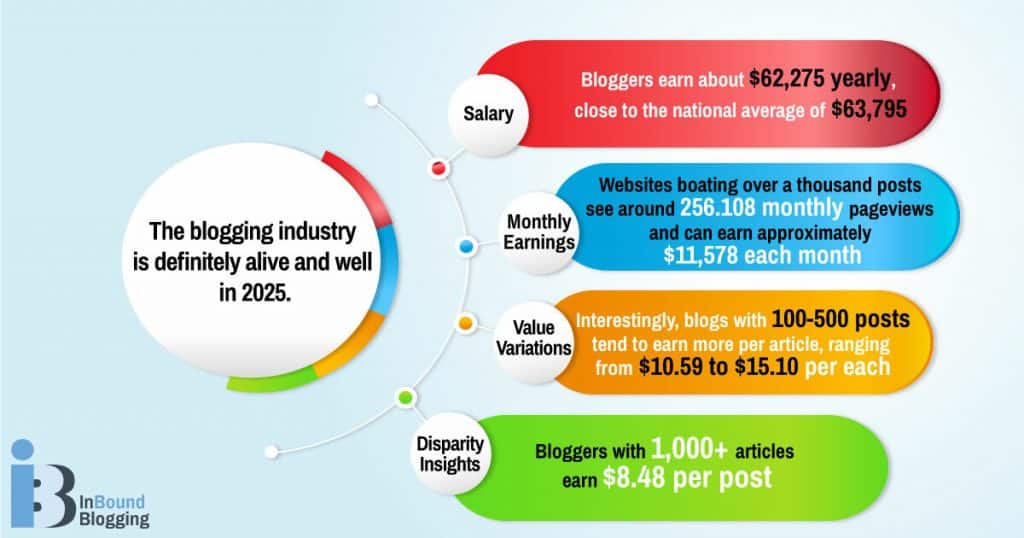
During my extensive research, I found that a blogger’s average salary is $62,275 per year. This is on par with the average annual salary in the US, which is $63,795.
The blogging industry is definitely alive and well in 2026. But many variables come into play when it comes to generating traffic and income from a blog. For instance, there is a solid connection between the number of posts you have and how many pageviews you get.
Sites with over a thousand posts get the highest number of pageviews (256,108 per month). They also earn the most money each month—about $11,578.
Interestingly enough, though, the average income per post is highest for sites with 100–500 published articles. Blogs with this many pages make anywhere between $10.59–$15.10 per post. For comparison, those with more than 1,000 articles earn $8.48 on average per post.
We can only guess why that is so. But as an SEO expert and blogger myself, I presume regularly updating such a huge body of work is extremely time-consuming, especially for solo bloggers.
6. Blogs that have been around for 5–10 years were generating $5,450.90 per month in 2024
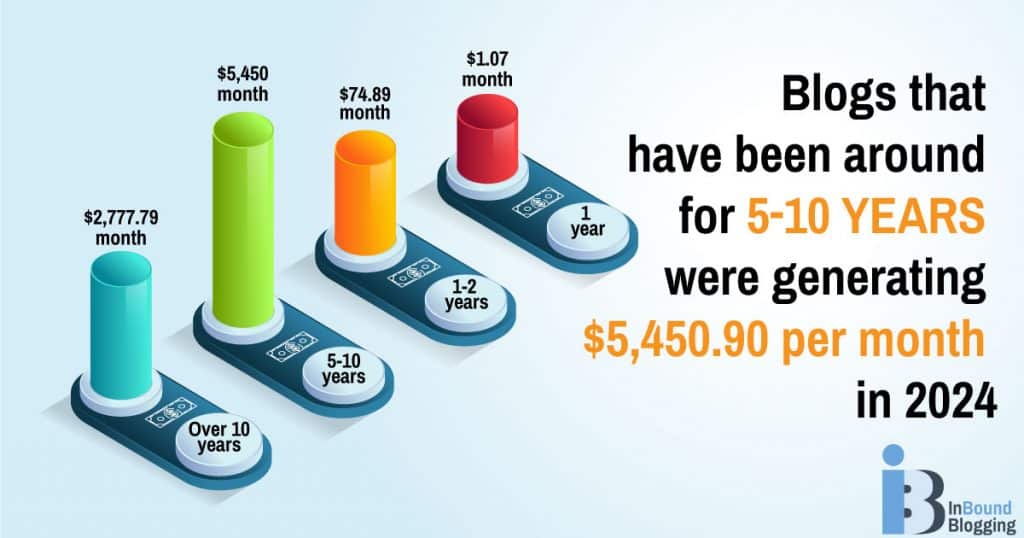
We all know that blogging is a long-haul game. In fact, there is a strong link between how long you’ve been posting and how much money you’re making. Essentially, sticking with it for at least a few years pays off in the future.
Unfortunately, the early days of blogging can feel as bleak as a ghost town. On average, active blogs that are under a year old make only about $1.07 monthly. But if that’s you right now, check out the numbers for those who’ve been blogging for a while for some motivation.
Those who have been posting for one to two years generate about $74.89 a month. A lot of bloggers quit too early, but these stats show that if you hang in there long enough, you might just hit the jackpot.
A blogger’s income keeps growing with time. On average, five to ten-year-old sites make the most money (about $5,450 a month). Surprisingly, those who have been writing for over 10 years actually make less on average—about $2,777.79 per month.
7. B2B companies with blogs score 67% more leads than those without
As an SEO expert who works mainly with B2B clients, I wanted to look at statistics for business blogs.
There’s no denying that a company’s website can be one of its best assets. Incorporating informative and helpful content can further elevate a brand and its online presence.
I found that B2B companies with blogs get 67% more leads than their counterparts without one.
Moreover, marketers who take blogging seriously are 13x more likely to have a positive ROI on their efforts. In fact, 57% of them have attracted new clients largely due to their blogging efforts.
But not all topics generate the same results. By far the most profitable blogging niches are personal finance and online business.
8. On average, a typical blog post contains 1,400 words
To rank on Google’s first page—or even better, in the number one position—an article has to meet a couple of criteria.
First and foremost, it must have bulletproof SEO optimization (as in having the right keywords inserted) and provide value to the reader. Once this foundation is in place, you have to give it that sprinkle of magic to set it apart from the other content available and ensure that it outranks the current positions.
In most cases, this translates into extra information added. So, what is the optimum length for a successful blog article?
Here’s what the latest statistics on blogs have unveiled:
- The average long-form blog post is 1,400 words.
- 37% of bloggers report that blog posts with a length of at least 2,000 words generate excellent results.
- Short-form posts just don’t cut it; only 10% of people who write short 500-word pieces actually see good results.
- Headlines with six to eight words can deliver an increased CTR of up to 21%.
- Article titles between 6 and 13 words usually get the most consistent traffic.
9. 80% of bloggers are leveraging AI tools this year
AI entered our lives and quickly transformed the way we share and interact with content online.
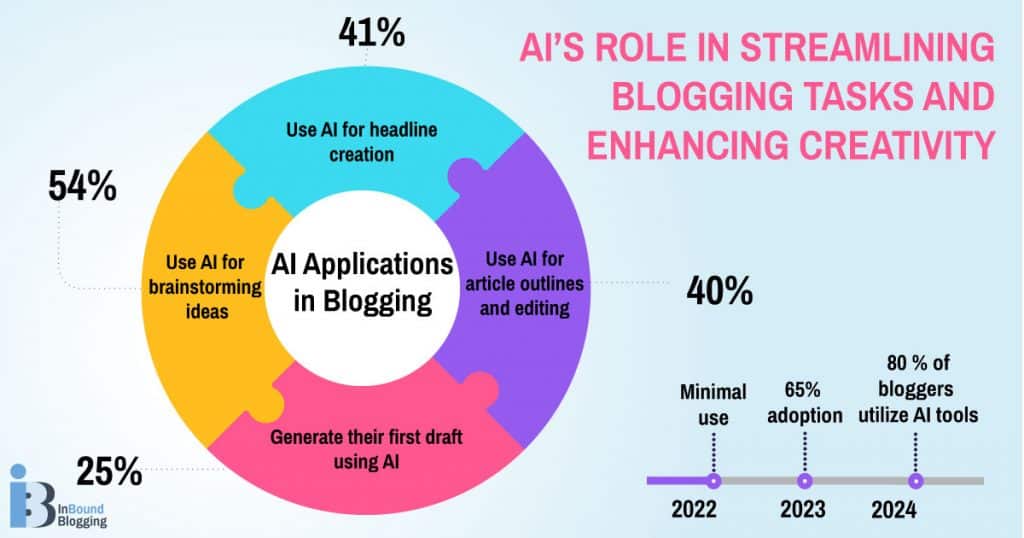
Back in 2022, bloggers scarcely used such advanced tools in their workflows. However, by 2023, AI adoption had jumped to 65%. As we are nearing the end of the year, 80% of bloggers utilize AI tools in various stages of their creative process.
How exactly are bloggers incorporating this new technology in their workflows? Let’s take a look at the data:
- 54% of creators use AI to brainstorm new ideas.
- 41% turn to AI for headline creation, and 40% use these tools to generate article outlines and suggest edits.
- One in four bloggers generates their first draft with an AI writing tool.
So, can we conclude that this has massively boosted efficiency? In some cases, yes, although recent statistics about blogging show that the use of AI doesn’t correlate with better content performance.
At the end of the day, quality writing and fulfilling user intent are what ultimately drives results.
10. Social media is the main promotion channel for 90% of bloggers
Unfortunately for writers looking for quick results, blogging is a long-term objective initiative.
Depending on the quality of your content, you’ll start seeing results sooner or later. However, to receive a visibility boost, you can do a couple of things. First, start interlinking your blog posts. This will help Google and other search engines understand your content better.
Moreover, social media is considered to be the most effective channel for article promotion, so it’s worth a try as well.
In the most recent statistics of blogs, 90% of bloggers mention social media as a primary promotion channel. In addition, 65% use SEO and email marketing to direct people to their content.
11. 71% of bloggers integrate visuals into their articles
Using visuals as part of their marketing strategy is common practice for 71% of bloggers. Integrating 10 or more images in an article can generate amazing results, according to 35% of bloggers. On the flip side, only 16% of bloggers are likely to report that using only one image gives them great results.
What’s the conclusion? Photos and infographics are a must-have for any blog article. They can make your writing easier to read and keep people engaged and interested.
However, it’s not just the quantity that matters. Quality is a huge factor as well. For instance, switching stock photos with ones portraying real people can drive a 35% conversion increase.
12. How-to articles are the most popular blog post format
There is no perfect formula for a winning blog post. And there are many different types of formats that writers publish.
However, “how-to” posts are the most popular article format, being preferred by about 74% of bloggers. This is followed by listicles (50%), guides (46%), and news on the latest trends (45%).
It makes sense since educational and informative articles are a big part of most content plans.
So, what other elements are bloggers adding to their posts?
One in four adds videos to their articles. It is a popular visual medium that enriches the user experience. The blog statistics don’t lie—25% of writers who add videos to their articles are seeing good results.
However, it’s not the most lucrative addition to a page. Surprisingly, audio content is a winning strategy for driving engagement. When added to blog posts (for instance, in the form of embedded podcasts), audio can improve an article’s performance by 45%.
13. Bloggers who regularly update older content are 2.5 times more likely to achieve strong results
Refreshing older articles is a fundamental aspect of an effective blogging strategy. Many bloggers (71%) are including updates in their content plans.
Although its popularity has decreased slightly this year, the impact remains substantial. Bloggers who spend time revising older posts are 2.5 times more likely to achieve positive results.
This method functions similarly to the work of editors—it refines and enhances existing material to maintain its relevance and value.
Final Thoughts
The first and most important lesson that all these statistics on blogging emphasize is how imperative it is for content writers to produce high-quality, well-researched pillar blog content. The fact that the average time needed to write a successful blog post continues to rise year after year is the best indication of that.
Another important takeaway from the statistics about blogs mentioned above is that if you want to improve your SEO in 2026, you must update your previous old posts.
To wrap up this list of business blogging statistics, I’ll give one last piece of advice.
The key to making outstanding blog posts, according to many marketing professionals, is to aim for evergreen content. Keep this in mind as you create your next content calendar.
References
- https://neilpatel.com/blog/content-marketing-statistics/
- https://www.hubspot.com/state-of-marketing
- https://videos.brightedge.com/research-report/BrightEdge_ChannelReport2019_FINAL.pdf
- https://optinmonster.com/blogging-statistics/
- https://contentmarketinginstitute.com/b2b-research/b2b-content-marketing-trends-research
- https://www.orbitmedia.com/blog/blogging-statistics/
- https://www.semrush.com/goodcontent/api/ai-content-marketing-report/download/Think_Big_with_AI_Small_Business_Content_Marketing_in_2024.pdf
- https://www.productiveblogging.com/how-much-do-bloggers-earn/
- https://www.semrush.com/blog/blogging-stats/
- https://www.sofi.com/learn/content/average-salary-in-us/
- https://futureofmarketinginstitute.com/wp-content/uploads/2024/06/Carney-and-Quill-2024-Marketing-Report.pdf