
When users type a query into Google, they rely on the SEO title to determine which page they should view.
If your title isn’t engaging enough, you won’t get clicks and traffic. Simple as that.
So, how do you create a title that delivers results?
Let’s find out.
Key Takeaways
- An SEO title, also known as a title tag, is crucial for informing both search engines and users about the content of a webpage.
- It impacts click-through rates, visibility, and overall SEO ranking by attracting more clicks and traffic.
- To create effective titles, keep them short (50–60 characters), relevant, and engaging.
- Avoid using all caps or excessive unique characters in titles, as they can appear unprofessional and spammy.
- Place important keywords naturally at the beginning of your title.
- Each webpage should have a unique, clear, and compelling title to help search engines distinguish between different content on your site.
What Is an SEO Title Exactly?
An SEO title, or title tag, is an HTML component that appears in multiple places throughout the internet. It provides both readers and search engines with information about each post or page on your site. The title tag typically appears at the top of an XHTML or HTML document, within the head tag. An alternative name can also be meta title.
In HTML, your title would look like this:
<head>
<title> Your SEO title </title>
</head>
On a website browser, this title will appear at the top of the browser tab or window, helping users and search engines identify the content. In search results, it appears as a bold, hyperlinked text. For instance:

Why Are SEO Titles Important?
Simply put, SEO titles provide both search engines and users with valuable information about what a website page or post contains.
Readers use titles to decide whether the page they’re about to visit is relevant to their needs. Search engines assess title tags as part of an overall SEO strategy, to determine where posts should be placed within the search engine results. For instance, if your customers are looking for the answer to “What is blogging”, they’ll be presented with pages that have these keywords in the title first:
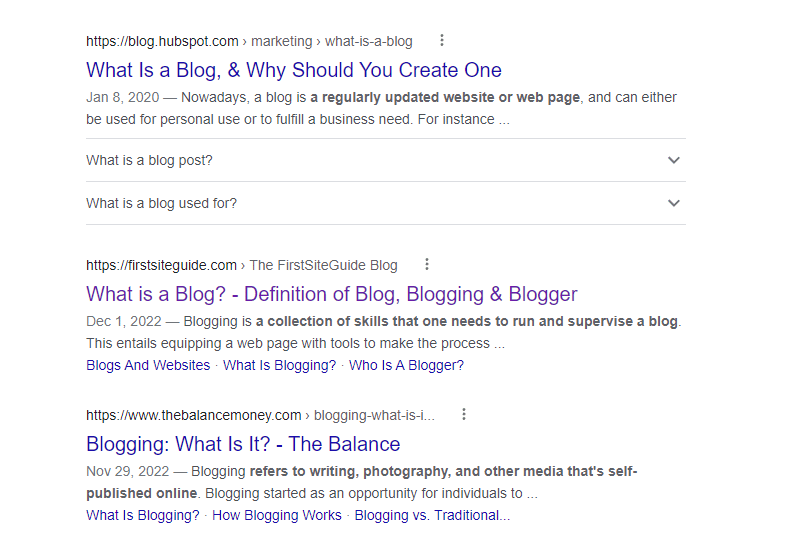
Considering that around 68% of online experiences begin with a search engine, title tags are a big deal. A poorly worded title can deter users from clicking on your website, while a strong one increases your traffic and site potential. Title tags are essential for visibility, and critical for highlighting the context of your piece.
Perhaps most importantly, title tags influence click-through rates (CTRs). Your click-through rate is the number of people who click your link, compared to the number of people who see your link and decide not to click. The more clicks you get, the more your SEO ranking increases. At the same time, more clicks also mean more traffic and opportunities for your blog.
How to Write Title Tags? Best Practices
Like most things in the writing and content production world, creating great titles requires a little practice. The more you work on your content creation methods, the more likely you are to comfortably create compelling titles. You’ll also be able to use analytics and reports from your website to determine what kind of titles get the most click-throughs over time.
Here are a few quick tips to get you started.
1. Pay attention to punctuation
Most titles don’t necessarily need a lot of punctuation. Since you’re going to be using relatively short headers for your posts, you can usually omit punctuation entirely. However, it can be helpful to use certain pieces of punctuation such as colons and dashes to share information.

If you’re going to include the name of your blog or website in your title, you can separate it from the rest of the post with a dash or a line.
2. Keep it short
As mentioned above, SEO titles need to be short, concise, and straight to the point. The longer your title is, the more likely it is to be truncated by search engines. A good rule of thumb is to ensure your titles are no more than 50 to 60 characters in length.
If you can remove stop words and extra unnecessary content from your title tag it’s usually a good idea to do so. Just avoid removing so much content that your title tag no longer makes sense.
3. Make it relevant
Ensure your title tags let your audience and search engines know exactly what your article covers. The last thing you want is for your customers to click on a title, only to be directed to a page without any of the information they need. Misleading titles can harm your search engine authority and increase your bounce rate.
Make sure you put the most important information about your blog at the beginning of the title. For instance, instead of: “Strategies and Guidelines: What Is SEO”, opt for “What Is SEO: A Complete Guide”.
4. Avoid all caps
When you’re trying to stand out on search engine result pages, it can be tempting to use various methods to grab your audience’s attention. You might want to use unique characters, emojis, and even capital letters in your title. However, this usually doesn’t lead to great results in terms of search engine optimization.
SEO titles are often viewed as unprofessional and spammy when written in all uppercase letters and using too many unusual characters. Format your title tag with title case capitalization.
5. Place keywords naturally
Keywords are crucial to title tags, because they help search engines, and your readers define whether your content has what they’re looking for. Including keywords in your title can increase your ranking potential, but it’s important not to stuff too many words into one sentence.
A good idea is to place the keyword you most want to rank for at the front of your title. For instance, if you’re trying to rank for “How to make money blogging”. These words should be the first the search engines and your customers see.
6. Give every page a unique title
Every page and post on your website should be unique. This means your page titles need to be unique too. Every title should be optimized to reflect the content found on the core page. Make sure your titles are clear, compelling, and relevant.
Even if a title gets good results, never duplicate it across different pages. This can harm your search engine rankings, because crawlers and search engine robots may struggle to differentiate between pages. Always double-check before publishing a page to make sure you haven’t used a title already.
7. Write your article first
Writing your article before you actually create the title can be a great way to ensure you include the right information in your tag. At the very least, you should use a blog post outline to ensure you know everything you’re going to cover. Think about your target audience and how they’re likely to search for information on the web. What kind of language they use, and how to attract them with a catchy title.
Final Thoughts
With your newfound understanding of what an SEO title is, it’s time to roll up your sleeves and start crafting irresistible title tags for your site. These concise snippets are the unsung heroes of content, pivotal in luring your audience and boosting your search rankings.
Aim for titles that are not only relevant and striking but also accurately reflect the content. Experiment with different styles, like thought-provoking questions or attention-grabbing numbers, to enhance search engine optimization.
Ready to uncover another WordPress secret? Read more to unlock the mystery of hiding page titles.