
Content-led link building is the practice of publishing high-value content that attracts backlinks from other websites. Original research, data reports, expert roundups, in-depth guides, and industry reports are the five formats that perform best.
I’ve spent more than 10 years building links for SaaS brands, and one pattern consistently stands out:
The content that earns the most links is the one that people find genuinely useful and trustworthy.
In this guide, I break down:
- Five content types that earn links
- How to find topics with content-driven link building potential
- How to promote your content assets through outreach
- The most common mistakes that limit your results
Key Takeaways
- Linkable content has 5 qualities: originality, visuals, authority, depth, and topical fit.
- Original research and data reports earn the most backlinks.
- Content must fit your site’s niche to be cited as a credible source.
- Outreach amplifies good content but never fixes weak content.
- One data asset produces multiple linkable formats through repurposing.
What Is Content-Led Link Building?
Content-led link building is a strategy where you create useful, original, or data-rich content that other websites have a reason to reference and link to.
It’s one of the SaaS link building tactics where, instead of cold-outreaching site owners and asking for a link, you create something that’s worth citing. This could be original research, industry data, or an in-depth resource.
You still promote the content and run outreach campaigns. The difference is that your outreach starts with a genuinely valuable asset, not a generic “link to me” pitch.
You invest more time upfront creating content worth linking to, then use outreach to get it in front of people interested in it.
Why Does Some Content Attract More Backlinks Than Others?
Content earns backlinks when it provides qualities that no other published resource offers.
I break these qualities into 5 categories:
- Originality and unique data: Original numbers, stats, or survey results give writers a clear reason to cite you. In fact, 95.9% of digital PR professionals use data-led content as their primary tactic for earning links.
- Visual assets: Charts, infographics, and custom diagrams make complex information easy to understand and reference. Other authors embed them in their own articles and link back to the source. A well-designed visual also increases social sharing and puts the content in front of more potential linkers.
- Authoritative opinion: Content with perspectives from recognized practitioners carries more credibility than a single-author article without external validation. When experts contribute their name and reputation, they also distribute it across their own channels.
- Comprehensive coverage: A resource that covers every angle of a topic becomes the default reference in that niche. Writers link to it instead of explaining the full context themselves.
- Topical fit: The content must fit your website and support your SaaS content marketing strategy. A data study is more likely to earn links when it comes from a site that covers the topic. If you regularly publish useful content in a niche, original research on that topic feels relevant and gives other websites a reason to reference your site.
What Are the Five Types of Content That Earn Links?
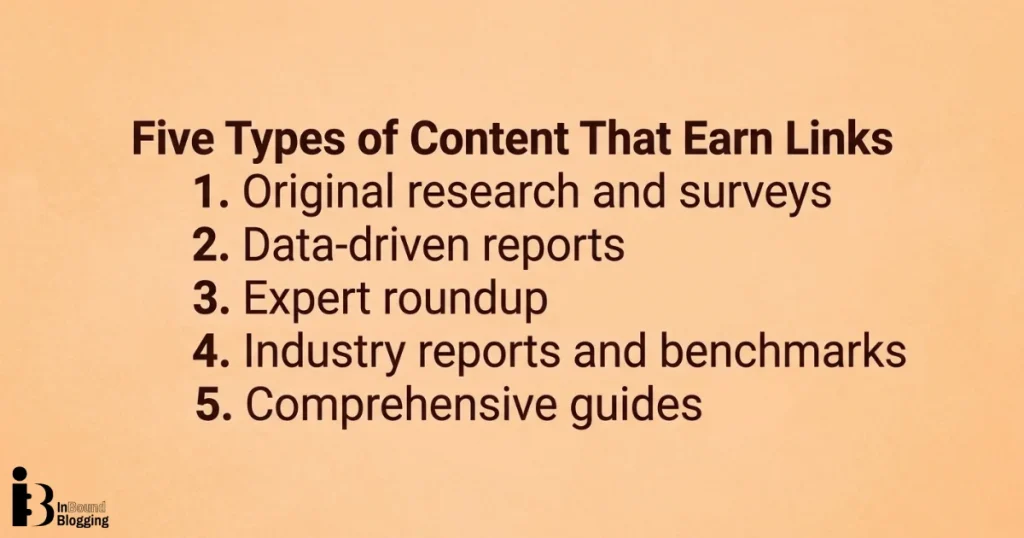
The five content formats that generate backlinks are original research, data-driven reports, expert roundups, industry reports, and comprehensive guides.
1. Original research and surveys
Original research is one of the most effective content types for earning backlinks through content.
When you publish original data that isn’t available elsewhere, journalists and industry writers can use your findings as evidence in their own articles.
For example, Mailchimp surveyed 1,400 small businesses in 6 countries about their marketing challenges and strategies. The research produced original findings that 43 websites included in their content.
This is the kind of survey you can create using an audience you already have access to, such as your customers or users.
My advice: Start with something you already have. Just like Mailchimp did.
Survey your user base about a relevant industry question, analyze anonymized product or customer data, or poll professionals in your industry.
You can then reuse the research for digital PR link building to pitch it to journalists and expand your reach.
2. Data-driven reports
Data-driven reports use publicly available information to answer a question or explore a topic from a new angle.
Unlike original research, you work with publicly available data rather than collecting new data yourself.
The value comes from how you analyze that information, identify patterns, and draw useful conclusions.
Anyone can access Google Trends or public SEO data. Your analysis is what creates the value.
Here’s an example of a report I did for my website that, in one year, brought me links from 955 domains.
Two years ago, I noticed that the keyword “most popular keyword” had a solid search volume, and I saw it as an opportunity to create research with the tools I already had—Ahrefs and Google Sheets. This is how I created “Top 100 Most Popular Keywords and Google Searches in the US.”
3. Expert roundup
Expert roundups are naturally linkable because contributors have a reason to share and reference the piece once they’re featured.
I add expert commentary to many of my articles. It brings first-hand experience and credibility to my topics.
On top of that, the content becomes original and strengthens its E-E-A-T signals. And when that content ranks well, more people discover it, which creates more opportunities for others to reference and link to it.
4. Industry reports and benchmarks
Industry reports and benchmarks turn original data into numbers others can use in their content. Writers need credible sources for statistics and claims.
If one-off surveys often answer a single question, industry studies show broader industry patterns, averages, or benchmarks.
SaaS companies are well placed to create this content because they have access to product data, customer surveys, and other industry-specific information.
For example, HubSpot, a marketing platform covering email, content, and more, publishes an annual State of Marketing report.
BuzzStream, an outreach platform, does the same with its annual State of Digital PR report.
Marketers like me use these studies to write statistics articles and industry guides. When I need a number to support a point, I look for original research and reference the company that collected it.
That is why annual reports work especially well for content-led link building. Trends change, people want to stay relevant, and an annual study gives writers a reason to reference you each year.
5. Comprehensive guides
A comprehensive guide gives readers one reliable resource for understanding a specific topic or completing a specific task. When it becomes a trusted reference, other sites have a reason to link to it.
Take Moz’s Beginner’s Guide to SEO as a strong example. 12,000 websites link to it. This guide has been a staple in the industry for years. I have employees who began their SEO careers with that guide.
A resource like this can naturally attract niche-relevant backlinks, which are valuable for a healthy link profile.
However, you need to be strategic about what you cover.
If you’re an SEO tool, it will be difficult to compete with a guide this established.
Instead, look for a more specific topic where you have knowledge, data, or a process that others can learn from.
The best opportunity is often something only your business can explain well.
How Do You Find Topics With Link Building Potential?
You find topics with link building potential by studying competitors’ content and spotting data gaps that will benefit from a credible source.
Here is my 5-step process:
- Start with high-volume keywords: Higher search volume usually means more people are interested in the topic and more content is being published around it. That gives you a larger pool of potential readers, writers, and publishers who could discover and reference your content. Volume alone is not enough, but it helps you identify topics with broader link building potential.
- Check what competitors get links for: Open Ahrefs, enter a competitor’s domain, and go to the “Best by Links” report. This shows which pages on their site have the most referring domains. A competitor’s data report with a high number of referring domains indicates strong link building potential for that topic.
- Look for missing data: Search for your target topic and notice where writers cite outdated stats or vague claims like “studies show that…” without linking to a source. That is your opening. Publish the data they lack, and they have a reason to link to you.
- Follow relevant journalists on X: Journalists often share the topics they’re looking into. When they cover a topic and struggle to find sources, that’s a content gap you can fill.
- Monitor rising topics early: Use Google Trends and topic research tools to spot subjects gaining traction before they get saturated. Being early means less competition for links.
Not every topic is worth your time. Focus on subjects where content gaps exist and where writers regularly look for sources to cite.
How Do You Promote Linkable Content Through Outreach?
To promote linkable content through outreach, you need to:
- Build a targeted prospect list: Find bloggers, journalists, and editors who have covered your topic in the past six months. They already care about the subject and are more likely to find your content useful.
- Lead with the value: Explain what makes your content useful to their audience. For example: “I published original research on [topic] based on data from [X number] of companies, and thought it could add useful context to your piece on [related topic].”
- Personalize the message: Reference a specific article, data point, or topic that is relevant to the person you’re contacting. Avoid sending the same pitch to everyone.
- Combine content with strategic outreach: You can manage content and outreach in-house or work with a link building company to scale promotion. Either way, outreach works best when you have genuinely useful content to promote.
For more on the outreach process, see my guide to how to do SEO outreach.
How Do You Turn One Content Asset Into Multiple Backlinks?
You can turn one content asset into multiple backlinks by finding more than one reason for other websites to reference the information it contains.
Here are 4 ways to earn more backlinks from the same content asset:
- Pull standalone data points: An original research piece with multiple data points gives you multiple standalone assets. Each one works as a social post, a quote for a journalist, or a data point someone can add to their article with a link back to the full study.
- Repurpose your content: Turn a data report into an infographic. Turn a comprehensive guide into a slide deck. Turn survey results into a LinkedIn carousel. Each format reaches a different audience and opens up new linking opportunities.
- Pitch different angles to different publications: One dataset supports multiple stories. A SaaS pricing study works as a “pricing trends” story for a SaaS blog, a “cost optimization” angle for a finance publication, and so on. Same data, different framing, more links.
- Update and republish: Annual data reports earn links every year when you refresh them. The initial investment is heavy, but every update adds a new wave of backlinks.
What Are the Most Common Content-Led Link Building Mistakes?
The four most common mistakes SaaS companies make with content-focused link building are listed below:
- Creating content that is interesting but not linkable: A thought-leadership piece about your company culture can get plenty of engagement on LinkedIn, but it gives bloggers little reason to cite it. Linkable content solves a specific problem, provides useful data, or teaches something people can reference.
- Going after saturated topics: Plenty of comprehensive guides already exist, but if you can find an underserved angle or fill the missing data gap, this should be your choice.
- Ignoring what your audience links to: Data-driven reports perform well in some niches. Free tools win in others. Study what gets linked in your specific industry before committing resources to a format.
- Failing to track results: Track how many different websites link to each piece of content you publish. Ten backlinks from ten different websites give you broader link coverage than ten backlinks from just two websites. Ahrefs can show you the referring domains for each page.
My Final Thoughts
Content-led link building works because it aligns your goals with the needs of other publishers. You create something valuable. They link to it because it makes their own content better.
The content-driven link building process is simple:
- Find a gap.
- Fill it with original data or a useful asset.
- Put it in front of the people who need it.
If you build your entire backlink profile using this model, the compounding effect will be hard to beat. One strong data report earns links for years when you keep it updated.
Stop chasing links—start creating content worth linking to. My SaaS link building service can help you build and promote it.
FAQ
How many backlinks does a single content asset generate?
A single content asset can generate hundreds of links. The number depends on three factors: the originality of the content, the brand authority behind it, and the distribution effort. A data report from a recognized publication earns more referring domains than the same report from an unknown site. Backlinks also compound. One citation from a high-traffic publication puts your content in front of more writers, and those writers become the next wave of linkers.
What is the best content format for earning backlinks?
Original research and data-driven reports outperform other formats. Industry data shows that 95.9% of digital PR professionals rely on data-led content as their primary link-earning tactic.
How long does content-led link building take to show results?
It takes from a week to several months for your content to acquire backlinks. Results depend on the niche, the content format, and the outreach effort. The initial push comes from outreach, and passive link acquisition builds over time as the content ranks and gets discovered organically. Annual data reports accelerate in their second and third year as they become the go-to reference in their niche.